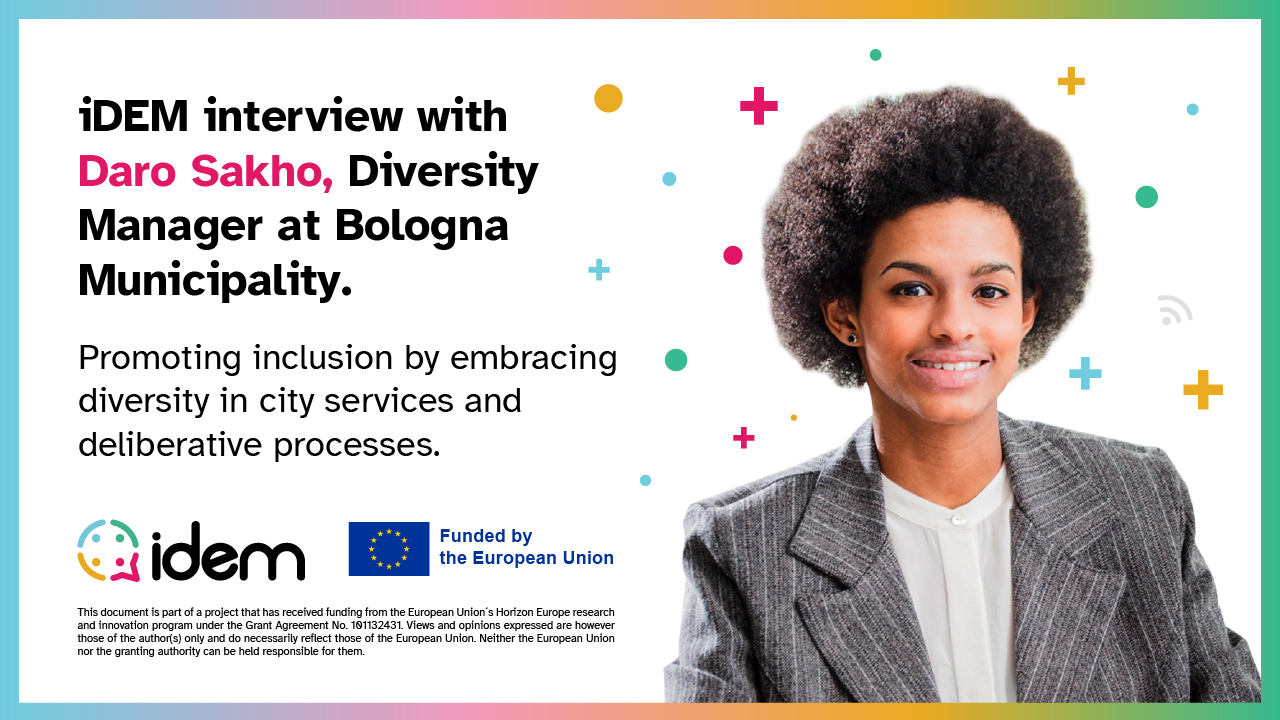
iDEM interview with the Diversity Manager at Bologna Municipality
31/03/2026 Francisco Alacio
Daro Sakho is a Diversity Manager at Bologna Municipality and a member of a five-person team appointed directly by the Mayor to work at the intersection of public administration and civil society. With a background in activism and intercultural cooperation, she brings community perspectives into municipal policymaking, helping to bridge the gap between institutions and underrepresented groups.
In this interview, she reflects on the role of local governments in fostering inclusive democratic processes, the importance of engaging communities from the earliest stages of policy design, and the power of municipalities to drive meaningful social change in Italy and beyond.
Could you briefly introduce yourself and explain your role as a Diversity Manager?
Thank you very much for the invitation and for giving space to our work. I am part of the Diversity Team of the Municipality of Bologna. We are five people appointed directly by the Mayor. We are not municipal employees; rather, we work as an external body positioned between the municipality and the city.
Our mandate is strictly linked to the Mayor’s term, so in 2027, when local elections take place, we do not know whether the team will continue.
All five of us are active citizens involved in local associations in different fields: disability, LGBTQI+ rights, anti-racism, and intercultural dialogue. In my case, I am part of two associations. One focuses on international cooperation between Italy and Senegal, as my father is Senegalese and my mother is Italian. The other works on anti-discrimination, anti-racism, intercultural communication, and global citizenship education.
Our role as Diversity Managers is to bring this activist and community-based perspective into the administration. We work with both municipal departments and civil society organizations, trying to bring the perspectives and concerns of associations into public policies. We essentially act as consultants.
The idea behind having five people instead of one is that diversity is too broad for a single person to represent. The more perspectives we include, the broader and more open our understanding of inclusion becomes.
You mentioned that local elections will take place in 2027. In your experience, what difficulties have you encountered when trying to include underrepresented communities in democratic processes?
One of the main challenges is that we cannot assume everyone shares the same understanding of democracy, public space, and inclusion.
For example, we worked on reducing the distance between public cultural institutions and people with migrant backgrounds. However, we realized that in many cultures, museums and libraries are traditionally seen as spaces for elites. In Senegal, for instance, museums are not always perceived as spaces for everyone.
So when someone with that background comes to Italy, they may not automatically see those institutions as places for them. We cannot simply say, “This space was designed for you—why don’t you use it?” We first need to understand how they perceive these spaces.
The starting point must always be dialogue. We need to establish a common baseline before designing policies. Otherwise, we risk creating initiatives that are available in theory but not truly useful for the community.
Do you think local democratic initiatives can have an impact at the national level in Italy?
Yes, absolutely. In Italy, many important initiatives start at the municipal level. Smaller municipalities can sometimes implement successful projects more easily because of closer relationships within the community.
Larger cities like Bologna have more financial and human resources, but the local level remains a powerful driver of change.
For example, regarding citizenship reform, Italy recently lost a referendum to change the law. However, since 2021, Bologna has symbolically declared in its city statute that anyone born in Bologna is considered Bolognese, even though national law does not grant citizenship at birth. This helped push the national debate forward.
Municipalities are often more accessible and responsive than the national government. Citizens can directly contact municipal offices and receive quicker answers. In Italy, local policies can sometimes be more progressive than national ones.
Are there any specific initiatives in Bologna that promote diversity and accessibility in democratic processes?
One important example is the UNITES project, which involved several European cities.
In Bologna, we focused on involving people with migrant backgrounds in evaluating early childhood services for children aged 0–6. We created an audit panel made up of community members who helped assess these services.
We developed practical questionnaires asking questions such as whether it was easy to apply for kindergarten or whether families faced administrative barriers.
The key was how we collected responses. Instead of relying only on formal surveys, we went where the community was. Some focus groups were facilitated in participants’ native languages. In other cases, feedback was collected informally—outside kindergartens while parents were waiting for their children, for example.
The principle is simple: go where the community feels safe. If we expect people to come to municipal buildings, participation may be lower. Inclusion requires adapting to people’s realities.
What recommendations would you give to other European municipalities seeking to foster more inclusive democratic processes?
First, communities—especially migrant associations—should not be involved only at the final stage of a project. Too often, they are asked for feedback after everything has already been designed.
They must be included from the beginning, in the design phase. They should be subjects of the project, not just beneficiaries or symbolic participants.
We also need to avoid tokenism. Associations should not be included merely to fulfill diversity requirements.
Finally, we must recognize that many associations are volunteer-based and not formally structured. Working with them requires flexibility and patience.
If people feel that the municipality only “needs” them but does not truly value them, they will disengage. Inclusion must start from the very beginning of the process.